

By the time I post this I will have started a new day job. During my brief, glorious unemployment, I went through my apartment and threw out a staggering amount of old stuff I didn’t need. Among the junk were some old treasures that it still made sense to part with. Buried deep in a box in the back of the closet, still sealed from my last move or maybe the move before that, I found a few CDs, some of them bearing price stickers from Amoeba Music in San Francisco. This archaeological clue fixes those purchases in time exactly, since I’ve only been to Amoeba once, in the summer of 2014.
As for the others, they were an assortment of bands and sources. There was a Post Stardom Depression disc that I probably got at one of their live shows, and a collection of Godspeed You! Black Emperor’s early albums.
I took a photo of a representative sample of them and, having no way to play any of them and having already long ago backed them up to digital copies, stuffed them in an anonymous black trash bag.
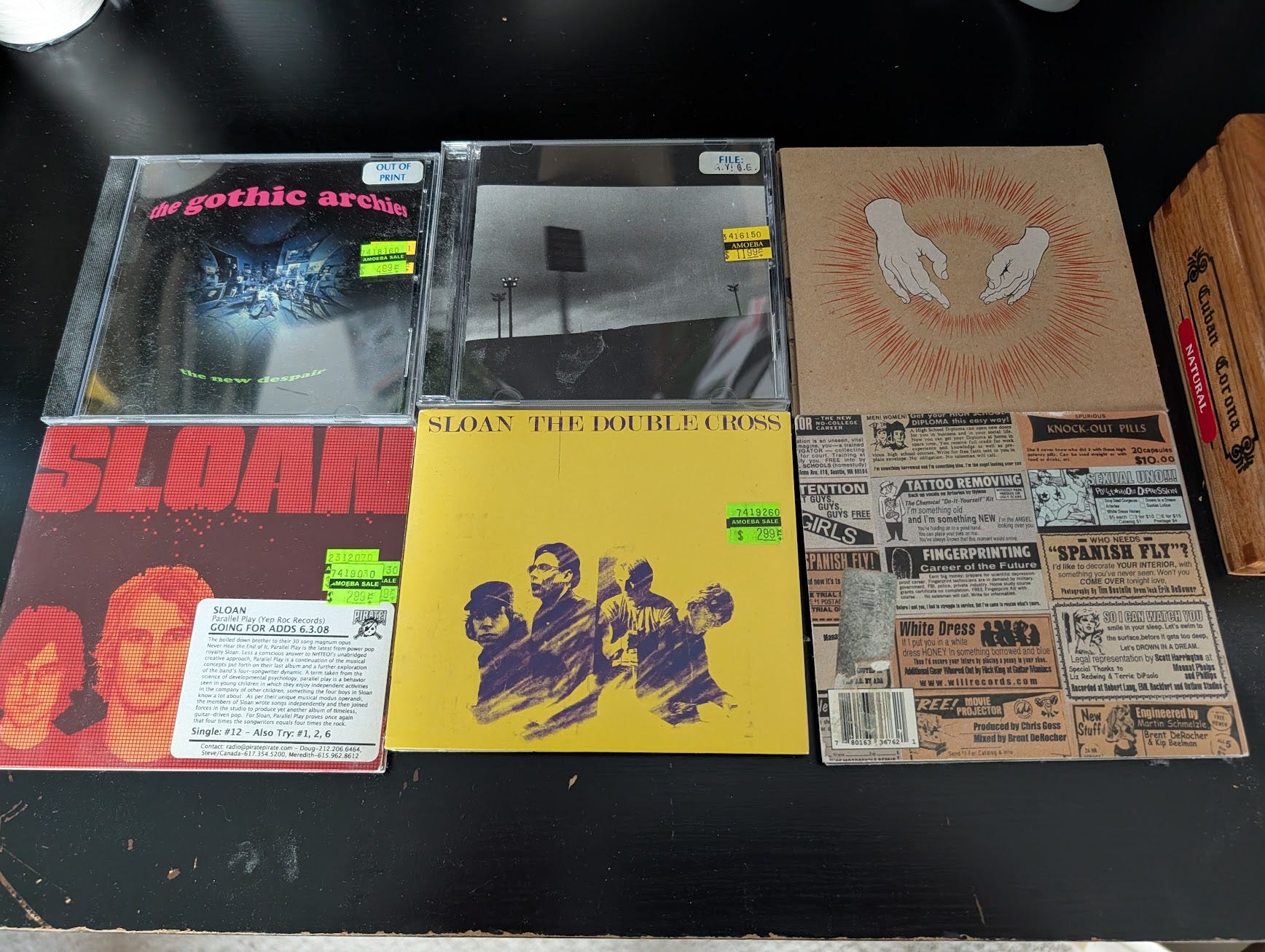
The Gothic Archies is a band that I completely bounced off of. I was never a particularly big fan of The Magnetic Fields, so a stripped down, more-twee knock-off act from frontman Stephen Merritt wasn’t ever really meant for me in the first place. It’s a testament to how much I was willing to take a flier on a record store bargain bin that I was willing to pay five dollars for a copy of The New Despair. It’s a testament to how little I was impressed with it that over a decade later I still consider it five dollars poorly spent.
Godspeed You! Black Emperor, on the other hand is very much my jam. I’m a little surprised that I didn’t own a copy of F♯ A♯ ∞ before that San Francisco summer. I’m sure I had heard the album and was already obsessed with “Dead Flag Blues”. Perhaps I’d pirated the album (shhh be cool don’t narc) and decided that I wanted a real copy.
Whatever the reason, I’ve felt that F♯ A♯ ∞ was something of the apotheosis of the DIY strain of post rock. It feels like a transmission from an alternate timeline. Or maybe the audio version of the They Live glasses. Listening to “Dead Flag Blues” while you walk through the modern world helps cast into stark relief an alien darkness that’s visible just under the surface of reality. If you can promise not to be creepy about it and triangulate my position, I’ll share an additional bit of musical biography with you.
At my old job, if I put on the CD version of “The Dead Flag Blues” right as I was leaving my apartment building to walk to work, it would finish almost as exactly as I was arriving at my office. I had to be careful with this fact, since so perfectly soundtracking my morning commute (especially under gray Seattle skies) produced a powerful psychic effect that was not always conducive with being a chipper and effective coworker.
Still a great way to start the day, though.
No one does fun sleaze quite like Jeff Angell. I’ve been a fan of his ever since I saw Post Stardom Depression share a bill with my hometown heroes Loudermilk back when I was in high school. Angell would go on to head up The Missionary Position and the veritable super group Walking Papers, but I’ll always have a deep affection for the brash, unpolished PSD days of his career. Hearing their Sexual Uno EP as an awkward teenager definitely changed a few things about both my musical and sexual cosmologies.
What doesn’t come through in the album versions of these songs is just how magnetic this whole band was live. I didn’t realize it was possible to flirt with an entire room until I saw Jeff Angell play live for the first time. The entire band threw themselves into grungy rock chaos with abandon. They had a dirty charismatic stage presence that had to be experienced to be understood.
I think it’s best glimpsed in these earliest recordings, however. Polish necessarily shaves off rougher edges and sometimes the rough edges are the best part of the music. Don’t get me wrong, I love Walking Papers and I think Jeff Angell’s newer music is some of the best rock coming out of Seattle in recent years, but sometimes I miss the grit and sleaze.1
I’ve always appreciated how many “not for resale” press discs were usually for sale at indie record stores back in the day. I had dozens of albums from 4,000 Holes in Spokane with radio notes and “Promotional Use Only” on them. This samizdat pipeline of free reviewer copies becoming fodder for local record shops helped expand my tastes significantly in the early 2000s.
I’m not a Sloan completionist, but I enjoy what I’ve heard and I don’t know if I’d ever bought one of their albums if it weren’t for those cheap illicit resales. Between their eclectic, wide-ranging style and the depth of their discography (they’re up to 14 studio albums), it takes some dedication to be a true Sloan fan. Instead, I get to own a few bargain-bin copies of their records and think of them as one of those bands that I should “get more into some day”. I doubt I will actually get more into them.
That being said, with glitzy, poppy gems like “Cheap Champagne” they make it sound pretty inviting. From the charmingly guileless “ba ba da” vocals to the jazzy guitar solo toward the end, it’s a fun, summery tune. Sloan’s ability to commit stylistically such a broad range of music is impressive. It comes as a bit of a surprise, coming after the stomping, crunchy “Believe in Me” that opens their 2008 album Parallel Play. The shift itself is probably a good symbol of why every time I dip into Sloan’s music, I feel like I get a different, but pretty enjoyable listening experience.
As an aside, PSD is one of the many local rock bands that followed the “One EP and Two Albums” lifecycle. I don’t know if this is just a trick of the music industry or if there’s some naturalistic explanation, but a lot of rock bands, when they break out of their local scene, have a strikingly consistent pattern. Record an EP/demo, get signed to a label (that is almost always troubled and often fucks them over), record a record, tour as the opener for a bigger act, record a second album, and disband shortly afterwards. I would love to read a sociological thesis about why this pattern occurs so often.