

We took the Clipper up to Victoria this past weekend. Our outbound journey was rough. I drank shitty coffee and did my best to work. The lingering winds that had been blowing all night frothed up the waters of the Strait into whitecaps. The boat rocked side-to-side. I kept having to look up from my computer to find some land to fix my eyes on. Fortunately the trip never takes one out of sight of the islands and cliffs of the Salish Sea.
We spent a few days hiking all over Victoria. We went for a couple of long walks in Beacon Hill Park. When rains came, we drank beer in a small beer hall in the market square. Brigid was very patient when, passing by a pinball bar, I took her up on her even kinder suggestion that we go in and play a few games. We spent some happy hours reading together in a brewery near the harbor.
One thing I noticed about Victoria is the diversity of architecture. While I’ve always been susceptible to architecture, I have to confess that I’m not very well read on the topic. My moods are unusually sensitive to human spaces and I often find myself deeply moved by the built environment I find myself in. This is especially notable, since I tend to be fairly emotionally constant in other respects.
Like all art, architecture is a communicative act. Every piece of every building is sending a message. To me, the language of architecture feels like a language of invitation. A well-designed building makes a case for the part of human life you want to engage in there. A well-designed dining room asks “isn’t this a great place to have a meal with friends?” A Cathedral invites us with “isn’t it right and proper to spend a few minutes in reflective and awe-filled prayer?” Even a government building like a DMV should raise the question “doesn’t this seem like a comfortable-yet-efficient place to do some government business?”
Brigid and I visited two historical homes on our trip. The first, Craigdarroch Castle, built by the the wealthy coal magnate Robert Dunsmuir, was well-architected in this sense. As we wandered through dark, wood-walled home we both commented on the several inviting nooks. Glittering stained glass hung above large windows, letting in ample light to offset the subdued, stately wooden interior. It was trivial to imagine drinking cognac with a friend in the smoking room in front of a fire, or reading by the light streaming into the sitting area on the landing of the grand central staircase.
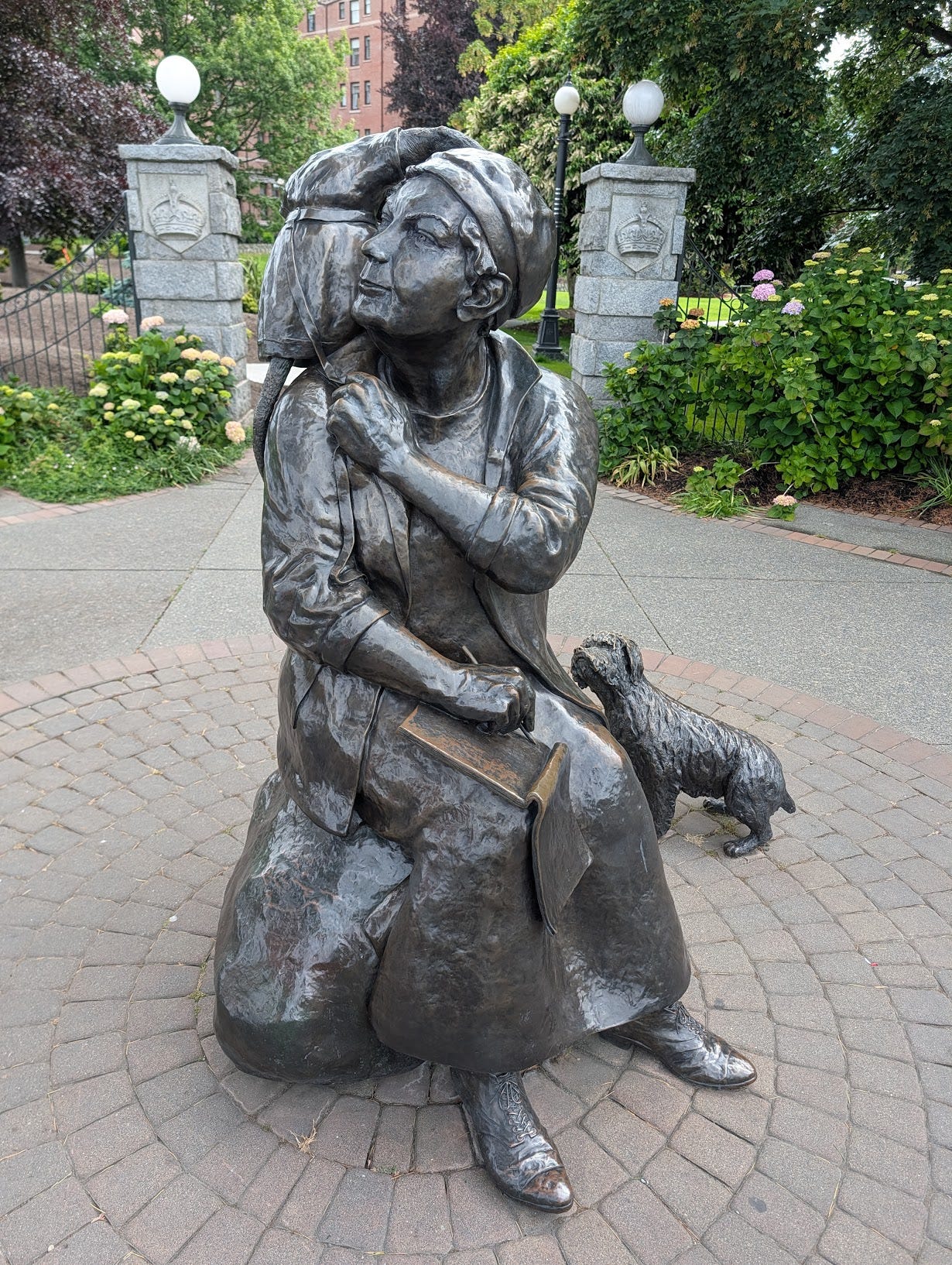
Victoria being the long-time home of Emily Carr, we stopped by her childhood home, now turned into a small museum of her life. There’s remarkably little of Emily Carr’s art in her home. The lion’s share of it is in the Vancouver Art Gallery on the mainland. We saw a few pieces of hers hanging in the smaller, well-curated Art Gallery of Greater Victoria, but as it didn’t exist during her lifetime, most of her work in public collections resides outside of her hometown.
The Carr house is cramped and threadbare. The structure of it is welcoming enough as a place to raise a family, though probably not one as large the Carr’s. (Emily was one of six Carr children to live to adulthood.) The main entryway and stairs are lined with fake marble, meant to evoke a status that Carr’s father, a solidly middle-class merchant, could only aspire to. It predates the more opulent Craigdarroch by thirty years and originally sat on four acres abutting the park. Sitting on a bench in the much-reduced side yard after touring the house, I tried to imagine the small home, not much larger than a modern townhouse, on a sprawling, four-acre lot. Perhaps this lot, backing onto a wild parkland that was a traditional gathering site for the local Salish-speaking people was part of what inspired Carr to become such a brilliant painter of nature and of the indigenous communities in the areas around the Salish Sea.
On our last day, while we waited for our evening sailing back to Seattle, we had tea and a few drinks in the Empress Hotel. The tea service is held in a grand ballroom. (And the room is “just for tea” as our bartender would later emphasize.) The high, ornate ceilings and tall windows looking onto the harbor give it a light and airy feeling. Despite being busy (almost every table was occupied throughout the time we were there on a Sunday afternoon), it was never loud and never felt crowded.
Despite not being hungry, I ate my way through almost all of the snack they provided. I had a mild and earthy pu’er. Despite being tourists in casual clothes and hauling a large backpack, it felt like a perfectly inviting space to engage in some high-class indulgence.
Our voyage home was smooth. The winds that made for a turbulent crossing on the way out had exhausted themselves. A pod of transient orcas made an appearance off the port bow.